Tattoo-friendly onsen in Hakone — and the ones that say no
42 of the 42 onsen we can publish here have an answer on tattoos. Last checked 2026/10/22.
Every onsen in Hakone where we have an answer on tattoos — the ones that turn you away as well as the ones that let you in. Of the onsen in Hakone listed on onsen pass, 42 have a known tattoo policy, and 30 of those let you in, some with conditions. The most common condition is "Cover with a patch".
Onsen we found will let you in
No restriction 10 · Conditions apply 20
Tattoo conditions: Private bath only
Tattoo conditions: Cover with a patch · Small only · Private bath only
Tattoo conditions: Private bath only
Tattoo conditions: Cover with a patch
Tattoo conditions: Cover with a patch · Small only
Tattoo conditions: Overseas visitors only
Tattoo conditions: Cover with a patch · Small only
Tattoo conditions: Cover with a patch · Small only
Tattoo conditions: Small only
Tattoo conditions: Cover with a patch · Small only
Tattoo conditions: No irezumi
Tattoo conditions: Private bath only
Tattoo conditions: Avoid busy times
Tattoo conditions: Cover with a patch
Tattoo conditions: Cover with a patch · Small only
Tattoo conditions: Cover with a patch · Small only
Tattoo conditions: Only when bathing alone
Tattoo conditions: Cover with a patch · Small only
Tattoo conditions: Cover with a patch · Private bath only
Tattoo conditions: Cover with a patch
Where conditions apply, you will be turned away if you don't meet them. Each onsen's page lists the conditions and the source. Please check with the onsen before you go to be sure your own tattoo fits.
Onsen we found will turn you away
12 onsenWe never list this on a guess — only where we found it stated, or were told so directly. The evidence and the date we last checked are on each onsen's page. Policies do change: some onsen dropped their restriction in 2025.
Hakone area guide: tattoos
What "Allowed with conditions" means
The conditions differ from onsen to onsen. Among the onsen in Hakone listed on onsen pass, the most common condition is "Cover with a patch" (12 onsen), followed by "Small only" (9 onsen). Other conditions include "Private bath only" (5 onsen) and "Overseas visitors only" (1 onsen).
- If you're going to an onsen that asks you to cover your tattoos, bring your own cover patches to be safe
- Size limits differ from onsen to onsen. Check the Tattoos section on the onsen's page, and if it doesn't say, ask the onsen
If the communal bath says no, try a private bath
Even if you can't use the communal bath, some onsen let you use a private bath, so you won't be bathing with strangers. Of the onsen in Hakone listed on onsen pass, 15 let you rent a private bath without staying the night. Some onsen turn away tattoos even in the private bath, so check the Tattoos section on the onsen's page.

Hakone's hot springs
Hakone has 17 hot-spring areas, large and small, known as the 17 hot springs of Hakone. The water varies from area to area. Typical spring types:
- Hakone-Yumoto and Tonosawa (where the mountain railway starts): simple springs, alkaline simple springs, sodium chloride springs
- Miyanoshita and Kowakudani (partway up the mountain railway): sulfate springs at Miyanoshita, weakly alkaline simple springs at Kowakudani
- Gora (the end of the mountain railway): calcium sulfate springs, sulfur-calcium-sulfate springs
- Around Lake Ashi: simple springs, simple sulfur springs
In Japan, hot springs that meet a legal standard (therapeutic springs) have official lists of conditions they may help with, by spring type. Chloride and sulfate springs, for example, are listed for poor circulation and dry skin, and sulfur springs for chronic skin conditions. None of this is a promise that bathing will cure anything. If you have a medical condition or aren't feeling well, you may be better off not bathing.
Bathing without staying the night
Some Japanese ryokan and hotels let you use their onsen for a fee even if you're not staying (day-use bathing). Hakone has both these inn baths and onsen built just for day visitors. Of the 42 onsen in Hakone listed on onsen pass, 31 let you bathe without staying the night. The rest are for overnight guests only.
Private baths can be for overnight guests only, too. Of the onsen in Hakone listed on onsen pass, 15 let you rent a private bath without staying the night.
Worth checking with the onsen before you go
- Hours: Day-use hours vary, and at ryokan, day visitors may only be allowed at certain times
- Towels: Some onsen charge for towels or expect you to bring your own
- Payment: Some onsen take cash only
- Language: Whether staff speak English depends on the onsen
For onsen etiquette and how to book a private bath, see these pages.

Getting there from Tokyo
From Shinjuku in Tokyo, the Odakyu Romancecar gets you to Hakone-Yumoto in about 85 minutes. The fastest trains take 75 minutes; the slowest take around 100. The Romancecar is a limited express with reserved seats, so you pay a limited express fee on top of the regular fare. You can book online in English.
If you have a Japan Rail Pass: The JR Pass covers JR trains only. It isn't valid on the Odakyu Line, the Romancecar or any transport within Hakone. A JR Pass will take you as far as JR Odawara Station. From Odawara, take the Hakone Tozan Line to Hakone-Yumoto.
Large luggage: You can't take large luggage on the Hakone Ropeway. At Hakone-Yumoto Station, the Hakone Luggage Transport Service will deliver your bags to where you're staying; you drop them off in the morning. Ropeway stations also have paid coin lockers.
The Hakone loop and what to see
On a first visit, the classic route is a loop from Hakone-Yumoto over the mountains to Lake Ashi, changing from the mountain railway to a cable car, a ropeway and a pirate ship. The rides are half the fun: each change brings a completely different view, from a hot-spring town in a valley to a steaming volcanic valley to a lake high in the mountains. You can also do it in reverse. The Hakone Freepass gives you unlimited rides and comes in 2-day and 3-day versions.
Hakone-Yumoto → Gora (Hakone Tozan Train, about 40 min)
The train climbs a steep gradient of 80‰ (80 m up for every 1 km), zigzagging up the mountain by reversing direction at switchbacks. In early summer, hydrangeas bloom along the tracks. Along the way, the Hakone Open-Air Museum displays sculptures outdoors and has a footbath that uses hot-spring water.
Gora → Sounzan (cable car)
At Gora, change to the cable car to climb higher up the mountain.
Sounzan → Owakudani → Togendai (Hakone Ropeway)
Owakudani was formed by volcanic activity about 3,000 years ago, and steam still rises from the ground. The view straight down into the valley from the ropeway is a favorite in reviews by overseas visitors. The local specialty is kuro-tamago, eggs with black shells; legend has it that eating one adds seven years to your life. On a clear day, you can see Mt. Fuji too.
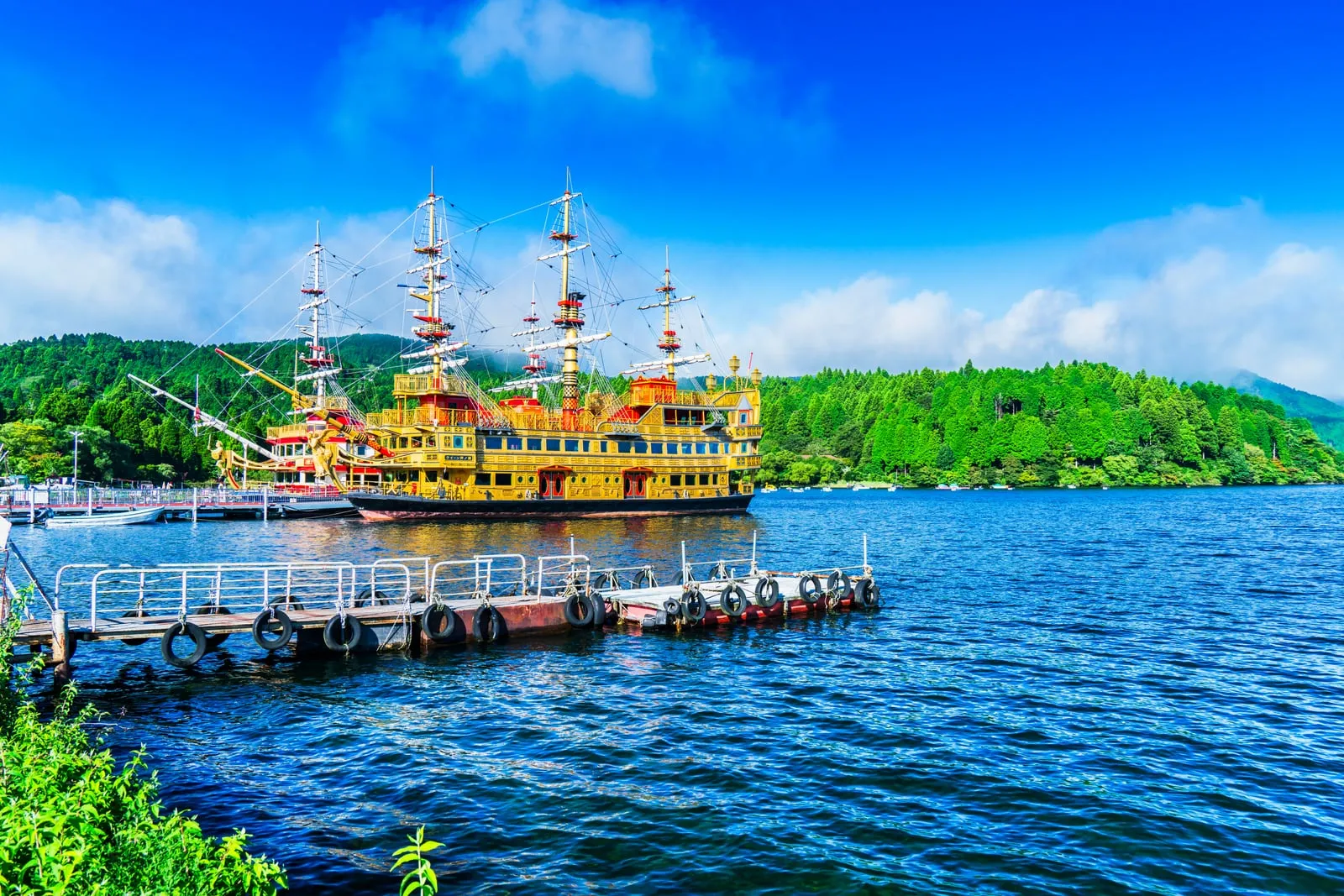
Togendai → Motohakone / Hakonemachi (pirate ship, about 25–40 min)
Crossing Lake Ashi, ringed by mountains, on a slow-moving pirate ship gives you a chance to sit back and catch your breath. At Motohakone is Hakone Shrine, whose buildings were first put up on their present site in 757.
Motohakone / Hakonemachi → Hakone-Yumoto (bus)
Take a bus back to Hakone-Yumoto.
For the onsen, we suggest either bathing at a hot-spring area along the loop, or ending at Hakone-Yumoto and bathing before you catch the Romancecar home.
Things to watch out for
The mountain railway and the ropeway sometimes stop because of bad weather or other reasons, so check service status before you set out. The area around Owakudani is a designated volcanic alert zone, and Kanagawa Prefecture asks people who are more vulnerable to volcanic gas, such as those with asthma or heart conditions, not to visit the Owakudani nature area.
Hakone through the seasons
Hakone's highlights change with the seasons. Peak times vary from year to year, so treat these dates as a guide.
- Late March to late April: cherry blossoms. Over about a month, the blossoms move from low-lying Hakone-Yumoto up toward Lake Ashi, so you can follow them up the mountain to wherever they're at their peak, which is part of Hakone's charm. In Miyagino, Somei-Yoshino cherry trees line the Hayakawa River for about 450 m.
- Mid-June to early July: hydrangeas. They bloom along the mountain railway, starting in low-lying Hakone-Yumoto and lasting until around July near Gora. The sight of the train gliding past the hydrangeas is one you'll only see at this time of year.
- Late July to August: fireworks and summer festivals. From late July into early August, fireworks go up over Lake Ashi from a different spot on the shore each night (Lake Ashinoko Summer Festival Week). With mountains all around, the bursts are reflected in the lake. On August 16, a fire in the shape of the kanji 大 (dai) is lit on the slopes of Mt. Myojogatake, which you can see from Gora (Hakone Gora Onsen Daimonji-yaki).
- Late September to early November: pampas grass in Sengokuhara. A meadow spreading up the mountainside is blanketed in pampas grass. Sengokuhara is about 30 minutes by bus from Hakone-Yumoto.
- Early November to early December: autumn leaves. The leaves start turning around Lake Ashi and Sengokuhara, then slowly work their way down to Hakone-Yumoto. As the air turns chilly, it's the season when you'll start craving a hot bath.
Transport and sights tend to be crowded on weekends and during Japan's holiday periods: Golden Week (late April to early May), Obon (mid-August) and New Year (late December to early January). On January 2 and 3, a university relay race (the Hakone Ekiden) runs through Hakone, which can affect roads and buses.
What overseas visitors say about Hakone
Here's what we often see in reviews from overseas visitors.
- "Great views from the ropeway." You look down on Owakudani's steam vents and Lake Ashi, and on a clear day you can see Mt. Fuji.
- "We couldn't see Mt. Fuji." Whether Fuji is visible depends on the weather. Some days it stays hidden in cloud all day.
- "The loop was crowded." Lines for the ropeway (especially during Golden Week) and scrambling for seats on the pirate ship come up a lot.
- "The ropeway wasn't running." It can stop in strong winds. Check service status before you set out.
- "The pirate ship is underwhelming on its own." Some say it's good as part of the loop.
FAQ
Are there tattoo-friendly onsen in Hakone?
Yes. Of the 42 onsen in Hakone listed on onsen pass, 30 let you in with tattoos. Of those, 10 let you in with no restrictions and 20 with conditions such as "Cover with a patch" or "Small only". We know of 12 onsen that turn away people with tattoos. Check the conditions in the Tattoos section on the onsen's page.
What does "with conditions" mean?
The conditions differ from onsen to onsen. Among the onsen in Hakone listed on onsen pass, the most common condition is "Cover with a patch" (12 onsen), followed by "Small only" (9 onsen). Size limits differ too, so check the Tattoos section on the onsen's page.
What can I do if I can't use the communal bath?
Some onsen let you use a private bath instead, so you won't be bathing with strangers. Of the onsen in Hakone listed on onsen pass, 15 let you rent a private bath without staying the night. Some onsen turn away tattoos even in the private bath, so check the Tattoos section on the onsen's page.
Can I use a private bath if I have tattoos?
At some onsen, yes. Of the onsen in Hakone listed on onsen pass, 25 have a private bath, and 22 of those let you in with tattoos, some with conditions. Check the conditions in the Tattoos section on the onsen's page.
What is Hakone like as an onsen destination?
It has a wide variety of hot springs, it's close to Tokyo, and there's plenty to see. Hakone has 17 hot-spring areas, large and small, and the water varies from area to area (the 17 hot springs of Hakone). From Shinjuku in Tokyo, the Odakyu Romancecar gets you to Hakone-Yumoto in about 85 minutes. You can get around sights like Owakudani, Lake Ashi and Hakone Shrine by changing between the mountain railway, the ropeway and the pirate ship.
Can I enjoy Hakone on a day trip, or should I stay the night?
Yes, a day trip is doable. From Shinjuku in Tokyo, the Odakyu Romancecar gets you to Hakone-Yumoto in about 85 minutes. There's a lot to see, though, so if you want to do the loop and enjoy the onsen, we suggest staying the night.
Can I use Hakone's onsen without staying the night?
Yes, at some onsen. Of the 42 onsen in Hakone listed on onsen pass, 31 let you bathe without staying the night. Day-use hours vary, and at ryokan, day visitors may only be allowed at certain times, so check with the onsen before you go.
How long does it take to get from Tokyo to Hakone?
From Shinjuku in Tokyo, the Odakyu Romancecar gets you to Hakone-Yumoto in about 85 minutes. The fastest trains take 75 minutes; the slowest take around 100. The Romancecar is a limited express with reserved seats, so you pay a limited express fee on top of the regular fare.
Can I use a JR Pass to get to Hakone?
Only part of the way. A JR Pass will take you as far as JR Odawara Station. It isn't valid on the Odakyu Line, the Romancecar or any transport within Hakone. From Odawara, take the Hakone Tozan Line to Hakone-Yumoto.
What should I do with large luggage?
You can't take large luggage on the Hakone Ropeway. At Hakone-Yumoto Station, the Hakone Luggage Transport Service will deliver your bags to where you're staying; you drop them off in the morning. Ropeway stations also have paid coin lockers.